
Smart Tiny House

From challenge to a reality -
bringing smart home features to our clients

Together, Vecmeiri and Mobi Lab set out to design standard smart home packages for tiny houses that bring together hardware, a cloud platform and a mobile app, along with a building process that is standartized and simple. The goal is to make smart homes simple and affordable, so buyers no longer have to choose between costly custom systems and a mix of separate gadgets.
Mobi Lab is an innovative technology company and digital product development agency based in Tartu, Estonia, specializing in user-centered design (UX/UI), software engineering, and IoT integration. With over two decades of experience, they bridge the gap between humans and complex technology by building scalable mobile applications, cloud-based software platforms, and intuitive digital interfaces for hardware systems.
The process
01 Building a joint understanding
tinyhouse.lv contributed its expertise in building tiny houses, along with demo house sketches, space limits for the electrical cabinet, and the house's insulation boundaries. Mobi Lab brought its expertise in software, user experience, and cloud technology. With a shared plan in place, tinyhouse.lv started building the frame of the demo house.
02 Listening to homeowners
We interviewed smart tiny house users and our past tiny house clients to learn what they actually value, what features were used the most, and what would fit seamlessly into their daily routines. They wanted physical switches for daily tasks like lighting. They valued seeing their energy use and checking on the house from afar. Above all, the system had to be reliable, with a manual backup in case of failure. Reliability was considered more important than price.
03 Choosing a reliable foundation
After evaluating several smart home stacks, Mobi Lab chose the decentralised, industrial-grade KNX standard with Home Assistant on top. This gave us an offline-first, hybrid-edge architecture where critical functions run locally inside the house, while the cloud adds remote access and monitoring.
04 Adapting the build to the technology
To bring the digital plan onto the workshop floor, we co-created an interactive digital wiring guide. Our electricians used it to route conduits, sensor nodes, and KNX bus lines through the timber frame while the demo house walls were still open.
05 Testing before shipping
In parallel, Mobi Lab built a hardware and software lab—a 1:1 copy of the house's central cabinet, wired on an industrial pegboard. Every KNX device was pre-programmed and tested there, together with the VPN, the cloud, and the mobile app, before being shipped to Latvia ready to switch on.
06 Bringing it to life in a demo house
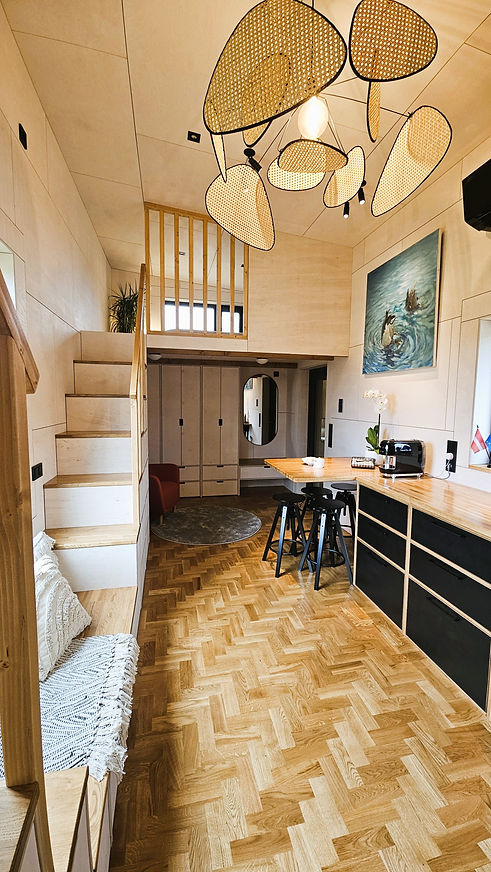
tinyhouse.lv finished the demo house at our factory in Latvia and installed the pre-programmed smart kits. For the first time, the whole system ran in a real tiny house. We then opened the doors for a demo day, where future buyers, builders, and partners could walk through the house, try the switches and the app, and share feedback on what to improve.
Challenge
Integrating smart technology into tiny houses while keeping the thermal envelope intact presents significant engineering hurdles, as standard wiring holes let heat escape.
Wesolved this by routing cables through a dedicated channel behind the inner wall, protecting the insulation layer and preserving energy efficiency. Furthermore, conduit volume expanded by 300% and standard fuse boxes had to be scaled up into full distribution panels for relays and gateways, requiring a careful redesign to maintain the exact exterior footprint and house layout. Because interior lining makes subsequent changes extremely costly, our craftsmen spent triple the time carefully placing and labelling cables, with both teams performing rigorous on-site verification while the timber frame remained open.
Solution
The collaboration has produced a standardized, pre-programmed smart home package that buyers can select easily. Utilizing an offline-first KNX platform connected directly to local hardware, essential systems—such as heating, ventilation, lighting, and boilers—continue functioning seamlessly even during internet outages, while remote mobile access is securely managed via Home Assistant cloud integration. Smart Tiny House demo unit built for real-world user testing, allows any interested client to see, test and choose the best smart home solution that suits their daily life.


Ready to talk about smart features?
Whether you are looking for your dream permanent tiny home or want to explore our modular housing options, we can help you find a space equipped with the latest smart living features.
-
Send a message: tinyhouse.lv@gmail.com
-
Call us: +371 2865 6926
-
Visit us: Vecmeiri, Liezeres pagasts, Madonas novads, LV-4884, Latvia